
COURSE IV · EDGE CONTROL
Edges in Oil Painting: Hard, Soft, Lost & Found Edges
Edges are like the punctuation in painting — used to emphasize or downplay certain areas and draw the viewer's attention to points of interest throughout the work. Learn the four types of edges and how each one shapes the way a painting reads.
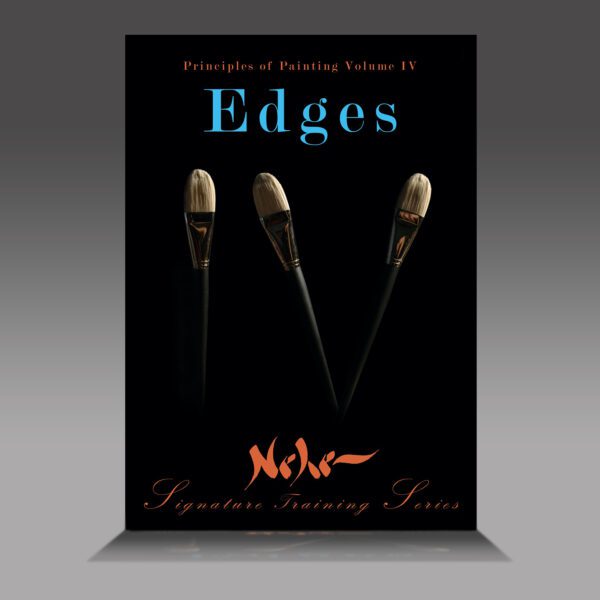
Course Overview
Punctuation in painting that guides the viewer's eye.
What Edges Are and Why They Matter
Edges are where two shapes or values meet in a painting — and they function like punctuation in language. Just as punctuation controls the rhythm and emphasis of a sentence, edges control the rhythm and emphasis of a painting. A hard edge demands attention; a soft edge recedes. A lost edge dissolves into shadow; a found edge snaps back into clarity. Used well, edges guide the viewer's eye through the painting, telling it where to look and how to feel.
Edges also contribute to the illusion of volume and depth. The human eye doesn't see every edge in a subject with equal sharpness — some are crisp and defined, others blur and fade depending on light, distance, and atmosphere. Reproducing that variety of edges in a painting is what makes forms feel round, spaces feel deep, and the whole image feel real rather than flat. Without edge variety, even a well-drawn, well-valued painting can look stiff and lifeless.
Hard Edges and Soft Edges
Hard edges are sharp, crisp transitions where two shapes meet with a clear, defined boundary. They're the equivalent of an exclamation mark — they draw the eye and say "look here." In a portrait, a hard edge might appear where the light side of a form turns sharply into cast shadow, or where the silhouette of the head meets the background. Hard edges are powerful, but overused they make a painting feel harsh and flat — every area competing for attention at once.
Soft edges are the opposite: gradual, blurred transitions where shapes blend into each other. Soft edges are where the eye is allowed to rest, where forms turn gently away from the light, and where atmosphere softens the boundary between subject and background. The interplay between hard and soft edges is what creates visual interest — contrast gives each edge meaning. A painting with all hard edges has no hierarchy; a painting with all soft edges has no focus. Learning to balance the two is the core of edge control.
Broken, Lost & Found, and Implied Edges
Beyond hard and soft, there are more nuanced edge types that give a painting sophistication. Broken edges are interrupted — a shape that's partly sharp and partly dissolved, creating a sense of texture and movement. Lost edges are edges that disappear entirely where two similar values meet, letting shapes merge seamlessly. Found edges are the opposite: edges that re-emerge from a lost area, re-establishing definition exactly where it's needed.
Implied edges are edges that aren't literally painted but are suggested by the shapes and values around them. The viewer's eye fills in the gap, creating a sense of the edge without the artist having to draw it. This is one of the most powerful tools in painting — suggesting rather than stating — because it engages the viewer as an active participant in completing the image. Brian explores all of these edge types through visual examples and a painting demonstration, showing exactly how and where to use each one.
Putting Edges to Work
The goal isn't to memorize edge types — it's to develop an intuitive sense of where each edge belongs and why. Through visual examples and a painting demonstration, Brian shows how to read the edges in your subject, decide which edges to emphasize and which to downplay, and use the full range of edge types to guide the viewer's eye through the painting.
With a strong understanding of edges, you have the final tool in the four-principle system. Drawing establishes the structure, value creates the form, color communicates the emotion, and edges direct the eye. Together, these four principles give you a complete framework for making decisions in oil painting — so you never have to guess what to do next.
What You'll Learn
Hard Edges & Soft Edges
Master the two foundational edge types — and learn when to use each to create contrast and focus.
Broken Edges
Create texture and movement with interrupted edges that suggest form without fully defining it.
Lost Edges & Found Edges
Let edges disappear where values merge, then re-emerge where definition is needed — the rhythm of a painting.
Implied Edges
Suggest edges without painting them, engaging the viewer's eye to complete the image.
Painting Demonstration Included
Through visual examples and a painting demonstration, Brian explores the importance of edges and explains the significance of each one and how to incorporate them directly into your own painting.
Ready to Start Edges?
2h of step-by-step video instruction. One-time purchase, instant digital download.